Learn how to read enemy economy in CS2 like a pro. Master money tracking, buy round predictions, utility cues, and strategic adaptations to dominate every match with smarter plays.

If you want to climb the ranks in Counter-Strike 2, mastering your aim isn’t enough. One of the most overlooked yet crucial elements of high-level CS2 gameplay is understanding and tracking the enemy’s economy. Why? Because every decision your opponent makes—what guns they buy, when they push, how they play corners—is rooted in one thing: their money.
Think of the CS2 economy as the heartbeat of the game. Each round’s outcome affects how much money players have to spend, which in turn dictates what weapons, armor, and utility they can buy. If you can predict whether your enemies are going to full buy, force buy, or eco, you can counter them with smarter positioning, better weapons, or even just the right amount of aggression.
Economic awareness gives you a mental map of what to expect. It’s the difference between getting surprised by a Deagle one-tap or playing safely because you predicted an eco round. If you’re wondering why some teams or players seem to always be one step ahead—it’s often because they’re not just playing the map; they’re reading the economy like a book.
Key Changes from CS:GO to CS2 Economy

CS2 builds on the foundation laid by CS:GO but introduces new dynamics and subtle tweaks that make reading the economy even more vital. While the basic economic structure remains similar, small changes like UI improvements, cleaner audio cues, and more visible scoreboard data allow you to gather more intel mid-game.
For example, the updated buy menu in CS2 makes it easier to see what your teammates and enemies might be purchasing based on timing and round progression. Also, CS2’s enhanced audio system means you can hear reloads, footsteps, and even utility usage more clearly—each sound revealing a bit more about the enemy’s financial state.
In CS:GO, players often relied heavily on visual cues and game sense. In CS2, there’s even more emphasis on integrating that with real-time feedback from the improved interface. This means newer players can start grasping economic patterns earlier, while advanced players can refine their reads to surgical precision.
In short, while the core economy system hasn’t been drastically altered, the way you interact with and interpret it in CS2 is more fluid and information-rich—making it even more important to master.
Understanding the Economy Basics

Money Distribution per Round Outcome
Let’s get this straight—money in CS2 isn’t random. It’s a finely tuned system that rewards certain actions and punishes others. Understanding how money flows after each round is your first step to reading the enemy economy.
Here’s a quick breakdown of what players earn depending on the outcome:
- Round Win (Non-Pistol): $3250 base income
- Bomb Plant (Terrorists): $800 (even if the round is lost)
- Bomb Defuse: CTs get $3500
- Round Loss Streak: Starts at $1400 and increases up to $3400
- Pistol Round Win: Usually nets $800–$1000, depending on kills
Add to this the individual kill rewards:
- Knife Kill: $1500
- SMG Kill (like MP9, UMP): $600
- Rifle Kill (AK-47, M4A1-S): $300
- AWP Kill: $100
Now imagine this: if the enemy team has lost three rounds in a row, they’re on a loss bonus of $2400. If they don’t get a bomb plant or many kills, it’s highly likely they’ll have to either full save or force buy. That’s your cue to play differently.
Players don’t always pay attention to these mechanics—but the top-tier ones do. And that’s why they’re able to predict if the next round will be an eco round or a dangerous full buy with rifles and full utility.
Understanding this basic economy logic lets you start predicting future buys and making calculated risk decisions. It’s like playing poker—if you know the odds and the bets on the table, you’re way ahead of the curve.
Tracking Enemy Spending Patterns
Weapon and Utility Tracking
Reading the economy doesn’t mean you need to hack into the enemy’s bank account—it means noticing the clues they leave behind. One of the best clues? What weapons and utility they carry into a round.
If the enemy team is suddenly buying SMGs after a round win, they might be preparing for a bonus round. This means they expect to win the next round without risking expensive rifles. Or if you notice two players didn’t buy head armor, it could be because they’re short on cash—or saving for an AWP in the next round.
Keep an eye on grenades too. If the enemy isn’t using smokes, molotovs, or flashes as aggressively as before, they might be on a tight budget. A team that normally throws three smokes per push and suddenly throws only one? That’s a red flag. Use it.
Here’s a practical tip: assign one player on your team (often the IGL or support) to note the weapons and utility of the enemy. After a round ends, quickly discuss what the enemy was using. Over time, you’ll build a pattern and start making smarter calls based on that.
Recognizing Buy Rounds
Full Buy vs Force Buy
Understanding the difference between a full buy and a force buy is key to countering the enemy. A full buy is when the opposing team has enough cash to purchase rifles (like the AK-47 or M4A1-S), full armor (with helmet), and all their desired utility—smokes, flashes, molotovs, and a defuse kit (for CTs). When you see a consistent amount of full loadouts, you’re up against a full-buy round. That’s when you want to play more structured and carefully.
A force buy, on the other hand, is when the enemy spends all—or nearly all—their money even if they can’t afford ideal weapons and utility. In a force buy, you’ll often see shotguns, pistols (Deagles, Tec-9s, Five-Sevens), SMGs, and limited utility. Force buys are risky plays where the team hopes to steal a round despite having inferior gear. If you recognize a force buy in time, you can counter it with strong setups: holding angles, playing long-range fights, and stacking bomb sites.
In a competitive match, the enemy’s round history can hint at whether they’re on a force or full buy. For instance, if they lost two rounds, won one, and then lost again, they’re probably low on money. It’s likely they’ll force in the next round to avoid going 4–1. Pay attention to the kill feed, sound cues, and scoreboard to validate this.
The key is to play smart. If you over-aggress into a stacked site against a force buy, you might lose to a well-placed shotgun or a cheeky Deagle. But if you recognize it early, you can control the tempo of the round—and possibly build your own economy by not losing expensive rifles.
Eco Round Indicators
Eco rounds are where the enemy spends little to no money—typically only pistols and maybe a flashbang or two. These rounds usually follow a string of losses where the team decides to save money to afford a full buy in the next round. So how can you recognize one?
- Sound Cues: Light footsteps, default pistols (like Glocks and USPs), and absence of rifle fire often indicate an eco.
- Utility Usage: Few or no smokes and flashes being thrown.
- Aggressive Stack Plays: Enemies may group and rush one site to overwhelm with numbers, trying to snag a lucky pick and take your weapons.
If your team is on a full buy and you realize the enemies are on an eco, don’t get overconfident. These are often the most dangerous rounds because players underestimate the threat. One misstep, and your rifle falls into the hands of a desperate eco player who can now turn the tides of the match.
To counter eco rounds:
- Maintain distance to avoid being swarmed by pistols.
- Use molotovs to delay rushes.
- Play crossfires so you’re not isolated and picked off.
- Don’t solo push—eco rounds are designed to bait greedy players.
Smart teams recognize eco rounds early and play accordingly, often farming up money with SMGs (which give higher kill rewards) and preserving rifles for long-term economy sustainability.
Understanding Anti-Eco Strategies
An anti-eco strategy is your team’s approach to safely navigating an enemy eco round without giving up weapons, map control, or momentum. It’s the most common round where teams throw away easy wins—because they don’t respect the desperation of eco players.
Here are a few effective anti-eco strategies:
- Slow Default Setup: Spread out and control all map areas. Don’t rush a site early. Let your AWPer and riflers pick off enemies trying to push or flank.
- Information Play: Use utility to gather info before committing. A molotov into an angle with no response might suggest a stack elsewhere.
- Bonus Weapon Farming: Let players with SMGs or pistols go first for the extra kill bonus (e.g., $600 for a MAC-10 or MP9 kill).
- Avoiding Narrow Chokes: Don’t all push a single corridor where you can be lined up. That’s a dream for a pistol player or someone trying to recover a gun.
- Group Trading: Always have someone nearby to trade frags. Eco rounds rely on isolating players—don’t give them that chance.
Remember, winning anti-eco rounds not only strengthens your economy but also mentally breaks the enemy. They took a gamble to reset your flow—and failed. That’s your cue to push the momentum further.
How to Use the Scoreboard for Economic Clues
What the Scoreboard Tells You
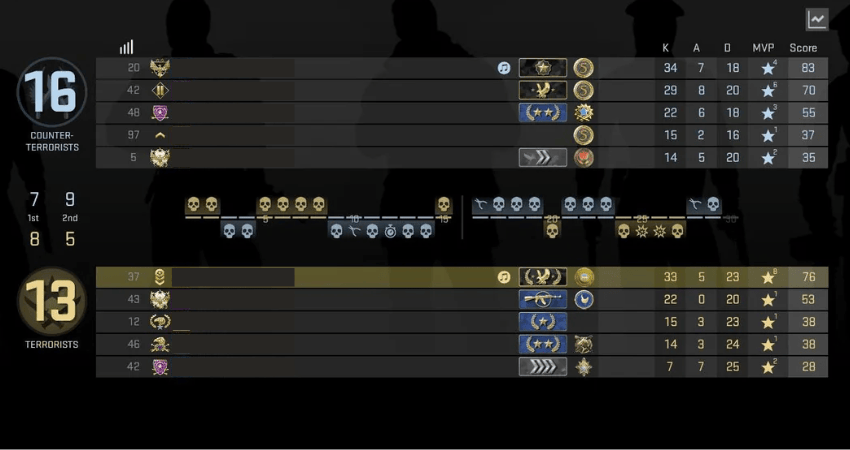
The scoreboard in CS2 is your silent coach. It doesn’t just show kills, deaths, and assists—it’s a live economic report card. Knowing how to interpret it properly can help you outplay your opponent before the round even starts.
Here’s what to look for:
- Money Columns: If you notice the enemy team’s cash levels are under $2000 across the board, expect an eco. If a few are hovering around $3500–$4500, they might force buy or drop weapons.
- Deaths & Kills: Players with high kills often have more cash from kills and round MVPs. If they’ve died several rounds in a row, they’ve likely burned through that cash.
- Round Win Bonuses: If you just won three rounds in a row, the enemy is likely at max loss bonus. Combine that with the money shown, and you’ll know if they’re saving for a full buy or about to gamble with pistols.
- Team Equipment Value (during buy time): Shows total investment. A low value means pistols or force buy. A high one signals a full buy with full utility.
Don’t just glance at the scoreboard—study it. It tells a story of what’s coming next.
Predicting Future Buys Based on K/D and Round Loss
Let’s get nerdy. If a player is sitting at 18–5 and hasn’t died in three rounds, they probably have bank. This kind of intel allows you to guess whether they’ll drop rifles for teammates or keep buying AWPs.
Conversely, if someone is 2–10 and has died every round, they’ll be struggling. They’re the ones likely to be using SMGs or downgraded rifles during force buys.
Combine this with team-wide round loss data. If the enemy has lost four rounds straight and didn’t save any rifles, you can bet they’re broke. But if they saved one or two AWPs or M4s, expect a mixed buy (known as a “hero buy”).
Reading the scoreboard with context—kills, deaths, and money—is what separates good players from great ones. You’ll never be surprised by an AWP again.
Using Scoreboard Timing to Your Advantage
In CS2, buy time is short, but if you’re quick, the scoreboard can give you split-second insights before the round starts. Watching how the enemy equipment values shift during those seconds tells you what they’re buying, and when.
For example:
- If the CTs have $1500 at the start and still show pistols during warmup, they’re likely saving.
- If someone had $4,500 but suddenly has a rifle and no armor, you know they’re taking a risk.
- Equipment value surging from $10,000 to $20,000? They just bought full utility—prepare for a full execute.
Treat the scoreboard like a weather radar. It may not predict every flashbang, but it sure as hell tells you when a storm is coming.
Using Sound and Visual Cues
Identifying Gun Sounds
In CS2, your ears can be just as powerful as your aim. One of the most underrated ways to read the enemy’s economy is by identifying gun sounds during a round. Each weapon in the game has a distinct audio signature, and recognizing these can give you real-time insights into what your opponents are carrying—without even seeing them.
For example, if you hear the rapid pop of a Glock or the loud crack of a Deagle early in the round, it might mean the enemy is on an eco or force buy. If you catch the unmistakable sound of an AWP firing from afar, it’s a warning that at least one player is heavily invested. SMGs like the MAC-10 or MP9 have high-pitched, rapid-fire sounds that are easily distinguishable and usually indicate a bonus or low-buy round.
Sometimes, hearing a Galil or FAMAS instead of an AK or M4 can signal a budget buy, where the enemy didn’t have quite enough cash for a premium rifle. This kind of information helps you decide how to position yourself: whether to hold long sightlines or close angles, whether to play aggressively or fall back.
Audio recognition is a skill that comes with time and intentional focus. Try watching pro matches or demo replays with headphones and isolate different gun sounds. Over time, you’ll be able to make snap decisions mid-round based on nothing but the noises around you. And in a game as fast-paced as CS2, that kind of edge can be deadly.
Utility Usage and What It Reveals
Utility—flashes, smokes, molotovs, and HE grenades—costs money. So the quantity and type of utility being used early in the round can reveal a lot about the enemy’s economic status.
A full-buy round from a coordinated team usually comes with layered smokes on chokepoints, multiple flashbangs, and molotovs to clear corners. But what if, during a rush, you notice a single smoke and maybe one flash? That might indicate a low-economy round, where the enemy couldn’t afford full utility.
Let’s take another example. You’re on the CT side, holding B site on Mirage. In a typical full-buy push, you’d expect to see:
- One smoke for the arch or market door
- One for bench or short
- Flashes to blind close angles
- A molotov for van or site corners
If they push with barely any of these, it’s a red flag that the round is either a force or an eco, even before you see their weapons. Similarly, if the Ts are entering with three molotovs and a full smoke wall, you can assume they’ve got money to spare, and possibly a set play in motion.
Pay attention to where the grenades land, how many are thrown, and when. Is it one flash at 1:55, or a coordinated burst at 1:40 with four smokes? That timing and volume gives away their economy and strategy.
Understanding utility usage is about looking beyond the boom and the smoke—it’s about reading the intention and the investment behind each throw.
Common Mistakes Players Make
Even experienced players sometimes misread the economy because they rely too much on guesswork or fail to adapt their reads mid-game. Here are a few mistakes you should avoid:
1. Ignoring partial buys: Just because you saw pistols doesn’t mean it’s a full eco. The Deagle armor combo or a Scout with light utility can be deadly. Don’t let your guard down just because you didn’t see rifles right away.
2. Underestimating upgraded pistols: A force buy with Tec-9s or Five-Sevens can absolutely destroy a disorganized team. If you don’t adjust your positions, use utility properly, or play together, you can easily give up a round.
3. Relying only on killfeed data: Seeing one player with an AK doesn’t mean they all have one. Watch for patterns, not just isolated kills.
4. Tunnel vision on sound cues: While listening for weapons is useful, relying solely on gunfire or footsteps can be misleading. Some players purposely bait audio or go quiet until the last second.
5. Not using the pause rounds to regroup: After a few confusing buys from the enemy, take advantage of timeouts to discuss and reassess. Maybe the enemy is playing mind games. Maybe they’re saving to double-AWP next round. Talk it out.
If you want to consistently outplay your enemies, learning from these common missteps is just as important as getting your shots right.
Coordinating with Teammates for Economic Reading
Role of the In-Game Leader (IGL)
The In-Game Leader (IGL) is often the brain behind a team’s strategy, but one of their most vital responsibilities—especially at higher levels of play—is keeping track of the enemy’s economy. They’re the ones calling for aggression when the other team is broke or opting for slower, more methodical play when the enemy is fully loaded.
An effective IGL doesn’t just call site hits—they’re constantly watching the scoreboard, monitoring weapon usage, and noting kill rewards to predict what’s coming next. For example, if they notice the enemy hasn’t planted the bomb in three rounds, they’ll likely predict a full save coming up. Or if an enemy saved a gun in a lost round, they’ll anticipate a risky mixed buy.
But the IGL can’t do this alone. They rely on information from the rest of the team. Was that a MAC-10 you heard on A? Did the enemy throw fewer smokes than usual? Every little clue helps the IGL form a picture of the enemy’s current and future financial state.
In lower-ranked games where an IGL might not be formally designated, this responsibility can be shared. Someone with good game sense can step up and say, “They’re probably broke next round,” or “Watch out—they saved two rifles.”
Whether you’re in a five-stack or solo queue, having someone consistently tracking the enemy’s spending trends can drastically change your team’s performance.
Callouts and Communication Strategies
Economy reading is a team effort. You don’t need everyone analyzing every detail, but you do need to communicate when you notice something significant. That might be:
- “Only one smoke on that B push—they’re low on utility.”
- “He had no armor and bought a Deagle—might be a force buy.”
- “Their AWPer saved—expect him to buy glass cannon next round.”
These little callouts help your team stay ahead. Instead of relying on your instincts alone, you’re pooling knowledge across five players, creating a shared tactical awareness.
Teams that consistently call out enemy loadouts, equipment, and utility usage can string rounds together with confidence—even when the scoreboard is tight. Use quick, clear phrases like “eco,” “force,” “full buy,” or “bonus round” to describe what you’re seeing. These terms standardize communication and avoid confusion.
And during dead rounds or timeouts, take a few seconds to talk economy. Ask:
- “How much do you think they have?”
- “Can they buy an AWP next round?”
- “Should we bonus round or play safe?”
These discussions make your team sharper and more strategic.
Tracking Economy as a Team Objective
Make it a habit. Just like tracking utility, map control, or kill/death ratios, tracking the economy should be part of your team’s round-to-round objectives. The more your team gets used to discussing money, the more intuitive it becomes.
Here’s how to integrate it:
- Assign a tracker: One player (usually the IGL or support) should be responsible for calling out expected buy rounds.
- Post-round reviews: After each round, spend 10 seconds reviewing what the enemy used. Did they have rifles or pistols? Did they save?
- Pre-round predictions: Before the next round starts, make a prediction: “They’re on a force buy,” or “Full eco incoming.” Test your assumptions against what happens.
- Mid-round reassessments: If you notice something odd during a round, call it out. Maybe they bought more than expected—adjust your plan on the fly.
Treat economy tracking as seriously as site execution or retake setups. It’s just another weapon in your arsenal.
Counter-Strategies Based on Enemy Economy
When to Play Aggressive vs Passive
Reading the enemy’s economy isn’t just about understanding what they’re holding—it’s about adjusting your strategy to exploit their weaknesses. One of the smartest decisions you can make is changing your playstyle depending on whether the opponents are on a full buy, force buy, or eco.
If the enemy is on an eco or force buy, this is your moment to play aggressively, but with structure. Push for map control early, challenge risky angles, and use utility to flush out common stacking spots. The key here is to dominate the round without handing over weapons—don’t push solo and get punished by a lucky pistol shot.
Playing aggressively against eco rounds also allows you to farm economy for your team. SMGs offer higher kill rewards, so this is a good opportunity to build your own bank while minimizing risk.
On the flip side, when you suspect the enemy is on a full buy, especially with AWPs in play, you want to shift to a more passive or methodical playstyle. Give them less room to get early picks, use smokes to block off sightlines, and wait out their utility. If you push into a stacked site or walk into an AWP’s crosshair, you’ve handed over the round.
Experienced players know when to flip the switch. Aggression without awareness can lose you the round, but aggression with a strategic purpose—especially when the enemy is weak—can snowball your lead.
Exploiting Weak Buy and Eco Rounds
One of the most valuable benefits of reading the enemy economy is knowing when to capitalize on their vulnerabilities. Weak buy rounds—where the enemy might have a mix of SMGs, pistols, or even a hero rifle—are ripe for exploitation.
If you’re on CT side and suspect a force or eco, stack more players toward bombsites likely to be rushed. Teams on low buys often rely on surprise and volume. Playing two close angles with crossfires and early utility (like a HE grenade or molotov) can completely shut down an eco push.
On T side, spread out in a default to find isolated players and pick them off before collapsing on a site. Don’t rush blindly unless you’re sure of the stack location. A well-placed eco stack can ruin a round if you’re not cautious.
Also, be wary of “hero buy” scenarios, where one enemy has an AWP or rifle while the rest are on pistols. These players often hold off-angles or try to bait you into giving up a weapon. Prioritize utility to flush them out, and always trade efficiently.
If you manage to shut down weak buy rounds consistently, you’ll not only win rounds but mentally and economically drain the enemy, pushing them into a cycle of broken buys and desperation plays.
Economic Pressure and Its Effects
Sustained economic pressure can break even the best teams. Imagine constantly forcing your opponents to rebuy armor, rifles, and utility every round. Eventually, they run out of money. They make bad decisions. They tilt.
You can apply economic pressure by:
- Killing all enemies even if the bomb is defused or not planted.
- Chasing down the last enemy instead of saving your guns if the risk is low.
- Burning enemy utility early, forcing them to rebuy every round.
- Avoiding costly losses yourself, so your own team stays rich.
This kind of pressure forces the enemy to play reactively. They can’t afford AWPs or kits. They second-guess rushes. You gain the upper hand not just tactically, but psychologically.
Reading Economy During Pistol and Mid-Game
Pistol Round Outcomes and Snowballing
Pistol rounds set the tone for the half. Win one, and you’re likely to take the next two rounds if you play correctly. But lose it, and you need to decide whether to force buy or eco for the third round.
Let’s say you’re CT and you lose the pistol round. The enemy is likely to buy MAC-10s or Galils. You can either force up with Deagles and armor, hoping to steal the round, or you save and buy fully in round 3. Reading what the enemy buys after their pistol win helps guide your response. If they go SMG-heavy, use long-range fights. If they’re skipping utility, expect faster rushes.
Winning a pistol round means capitalizing on your economic advantage. Don’t overbuy—stick to SMGs and limited rifles to build cash. The goal is to reach round 4 with strong rifles and full utility while the enemy is still scrambling.
One mistake players make is assuming they’re invincible after winning pistol. Underestimate a force buy, and you’re giving the enemy a chance to snowball their economy instead.
Mid-Game Reset and Bank Break Points
Mid-game is where economy manipulation becomes an art. If you’ve been trading rounds back and forth, pay close attention to when the enemy’s loss bonus resets. This happens when a team wins a round after losing several. Suddenly, they get minimal money next round if they lose again.
This is your opportunity to break their economy.
Let’s say the enemy has lost 3 rounds in a row, then wins one. Their loss bonus resets to $1400. If you win the next round, they’ll likely have around $2000 or less—forcing them into an eco or force buy. These are called break points—rounds that can shift the half in your favor dramatically.
Smart teams identify and play around these rounds, giving them extra attention, saving utility, and making safe plays to avoid economic resets themselves.
Adjusting Your Game Plan Dynamically
No strategy in CS2 should be static. The best teams and players adapt their playstyle based on the enemy’s money. If you see the enemy has been losing for multiple rounds, don’t just repeat the same strategy. Expect aggression. Expect risky pushes.
If the enemy suddenly goes silent for 40 seconds in a round, they might be trying to bait your utility or set up for a last-second push with saved weapons. Adjust your positions, save molotovs for late round plays, and don’t over-rotate.
Economy reading should influence:
- Your buy decisions
- Your positions
- Your pacing
- Your risk level
That’s how you stay one step ahead every round.
Advanced Tactics and Mind Games
Faking an Eco or Force Buy
Here’s where things get spicy. Just as you’re reading the enemy economy, they might try to deceive you. One common tactic is faking an eco—where a team pretends to be on low buy but secretly has full rifles and utility.
How do they do it?
- Run default pistols and play passive early
- Throw a single flash or smoke to mimic an eco rush
- Bait aggressive CT pushes with a “pistol round” setup, only to punish with full rifles
If your team rushes in thinking it’s a free eco, they could walk into a deathtrap. You can counter this by confirming weapon types early with sound and visual cues and communicating quickly with your teammates.
Manipulating Enemy Reads
Just like poker, sometimes you want to send the wrong signal. If you know the enemy is tracking your buys, you can intentionally throw them off.
Examples:
- Light buy with one AK and full utility to mimic a full buy
- Saving even though you had money to buy, baiting them into a false sense of advantage
- Double AWP after several rifle rounds to surprise the enemy’s default setup
This is high-level play, but once you master economy tracking, manipulating enemy expectations becomes an effective part of your strategy.
Economy Bait and Switch Plays
A clever tactic is when you show one weapon class early, then switch gears. For example, flash mid with pistols, bait rotations, then execute A with full rifles from another direction.
Or show light utility and no armor, then stack one site with rifles for an unexpected hold. These plays work because they exploit players who read the economy but don’t confirm it.
If you can force the enemy to over-rotate, waste utility, or hold the wrong angles, your “bad buy” becomes a deadly ambush.
The Role of Demo Reviews in Improving Economy Reads
Reviewing Pro Matches
Want to master economy reads? Watch the pros. Study how top teams manage their buys, adjust their pace based on enemy money, and coordinate drops and force buys.
Look for:
- When they save vs when they force
- How they manipulate the enemy’s assumptions
- How quickly they adapt after losing streaks
Watching matches with commentary can help you learn how analysts break down economic decisions in real time.
Analyzing Your Own Games
The best way to learn is by reviewing your own gameplay. Use demo replays to look at:
- Times you lost to eco rounds—why did it happen?
- Missed opportunities to break the enemy economy
- Poor buy decisions or mistimed force rounds
Keep a note of rounds where your assumptions about the enemy economy were wrong. Learn from them.
Identifying Patterns and Mistakes
After enough demos, you’ll start seeing patterns:
- The same player always buys Deagle on eco
- Certain teams always force after pistol losses
- You tend to rush blindly after winning a round
Pattern recognition is at the heart of economy reading. It’s what allows pros to make educated guesses—and it’s what will make you more consistent.
Conclusion
Mastering how to read the enemy economy in CS2 isn’t just for pros or analysts—it’s a vital skill that separates smart players from average ones. When you understand the flow of money, track spending habits, listen for weapon sounds, watch utility usage, and communicate effectively, you gain the power to control not just rounds—but entire halves.
Being economically aware lets you adapt your playstyle, exploit weaknesses, and apply pressure when it matters most. It turns you into a thinking player—someone who doesn’t just react but predicts. So the next time you’re in a tight match, don’t just watch the bomb timer. Watch the money.
Because in CS2, those dollars are just as deadly as bullets.
FAQs
What is the best way to track enemy economy during a match?
Use the scoreboard to watch cash levels, combine that with weapon sounds, utility usage, and communication with teammates to form an accurate picture of the enemy’s financial status.
How can I tell if the enemy is on an eco round?
Look for default pistols, light utility usage, aggressive stack plays, and quick pushes. Also, check their money before the round starts—if most have under $2,000, it’s likely an eco.
What’s the difference between a force buy and a half buy?
A force buy means spending all available money on the best possible gear, usually pistols, armor, and limited utility. A half buy (or light buy) means spending some cash (like $1,000–$1,500) to remain competitive without sacrificing the next full buy.
How do pro players read the economy so accurately?
They track every round’s outcome, communicate constantly, study patterns, and use audio-visual cues to build a mental map of the opposing team’s economy throughout the game.
Can you manipulate the enemy’s economic decisions?
Yes, by baiting false tells like faking an eco, delaying utility usage, or alternating buy patterns, you can trick the enemy into misreading your economy and playing incorrectly.